Aspire Nautilus 3: dialling in a precise MTL draw
Some tanks are judged on a specification sheet and others on what they do at the lips. The Aspire Nautilus 3 belongs firmly to the second group. The Nautilus line was built on one idea, which was to give the mouth to lung draw a genuinely fine adjustment rather than a fixed compromise, and this tank is where that idea is easiest to exploit.
Here is how the draw is actually dialled in on the Aspire Nautilus 3, and what each of the three adjustments really changes at the lips.
Which generation the Aspire Nautilus 3 actually is
The Nautilus family runs across several generations, from the original through the Nautilus 2 and 2S to this one, alongside separate lines that share the name but not the design.
This article deals only with the tank generation. Pod based products carrying the Nautilus name work on a different principle with their own cartridges, and nothing described here transfers to them directly.
That distinction is not pedantry. A large share of disappointment with this tank comes from a coil bought for one generation and fitted to another, producing a result that matches nothing anyone expected.
One regulatory point is worth stating at the outset. Every refillable tank sold in the United Kingdom is capped at 2 ml, so any larger capacity you see quoted on an international listing does not describe the version on sale here.
The airflow ring, the real control on the Aspire Nautilus 3
This is the heart of the matter. The tank offers seven airflow positions, selected by a rotating ring at the base, and British reviews consistently describe openings running from roughly 0.8 mm at the tightest setting to around 3 mm at the widest.
That span is what makes the tank interesting to anyone chasing a precise draw. You are not choosing between closed and open, you are moving along a progression and stopping exactly where the resistance at the lips becomes comfortable.
In practice the narrowest positions give a genuinely tight draw with discreet vapour and a clearly present throat sensation. The middle positions open into a semi restricted draw, airier but still firmly under control.
The widest positions edge towards a restricted direct draw. Vapour volume climbs, the throat sensation softens, and the feel in the mouth changes completely. It is the same tank, but it behaves like two quite different products.
One remark comes up repeatedly in owner feedback. The ring turns freely rather than clicking from position to position, which is excellent for fine adjustment but means the setting can drift after a refill or a spell in a pocket.
What the coil value changes at the lips
The airflow never works alone. The value fitted decides the heat, the volume of vapour and how the liquid is delivered, and both adjustments have to point in the same direction.
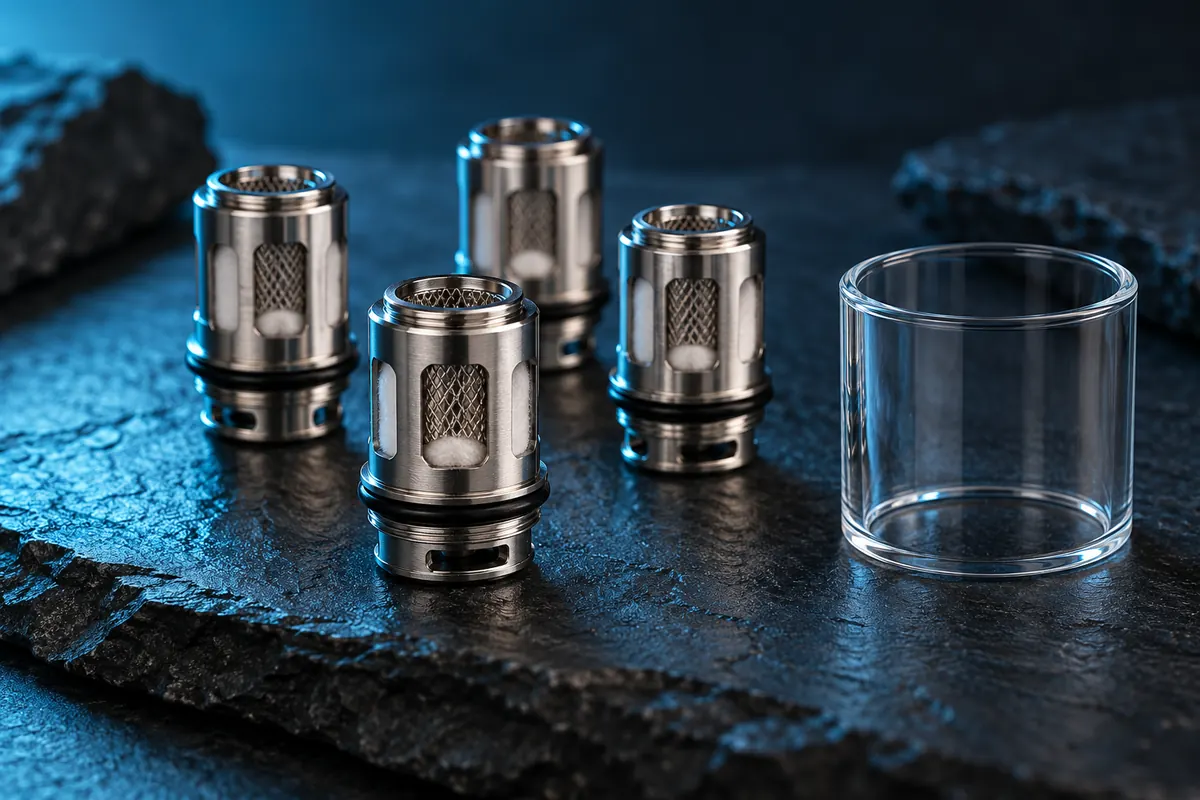
The tank is generally supplied with two coils of deliberately opposite character. A 1.8 ohm BVC coil, quoted for use somewhere around ten to fourteen watts and aimed squarely at the tight draw, and a 0.7 ohm mesh coil, quoted around twenty to twenty five watts for a more open one.
The general principle applies here as everywhere. The higher the value in ohms, the more discreet the vapour and the more coherent it is with a closed airflow, while a lower value heats harder and demands more air to stay pleasant. That reasoning is worked through in our guide to coil resistance.
The classic error is fitting the low value coil while leaving the airflow nearly shut. The vapour produced has nowhere to go, heat builds in the mouth and the result becomes stifling. The reverse also happens, a high value coil with the air wide open giving a lukewarm vape with no body.
On compatibility, several consistent sources indicate that the brand’s Nautilus BVC coils fit this generation. For any other reference, check the generation stated explicitly on the packaging rather than trusting a visual resemblance.
Setting a tight draw step by step
Here is a method that avoids days of trial and error. It is written for this tank but holds on most adjustable airflow tanks.
First, choose the coil before the airflow. For a tight mouth to lung draw, start from the highest value available in the compatible range, the one that heats least and produces least vapour. That choice frames everything after it.
Second, set the wattage inside the range printed on the coil itself, beginning at the bottom of that range. Move up one watt at a time until the flavour opens out, and never go past the upper figure quoted.
Third, close the airflow completely and then open it very gradually. Draw at each step, judging only the effort at the lips rather than the vapour. The right setting is where air passes without strain but the draw still pushes back clearly.
Fourth, leave the setting alone for a full day before changing it. A draw is judged over ordinary use rather than three puffs, and a great many settings dismissed as wrong turn out to be exactly right in daily service. The underlying logic of the two stage draw is set out in our guide to MTL vaping.
Matching the e-liquid to the draw
A tight draw and a high value coil call for a blend weighted towards propylene glycol, thinner and cleaner in flavour. A ratio heavily loaded with vegetable glycerine feeds a fine coil poorly and raises the risk of a burnt note.
Strength follows the same logic without ever becoming a recommendation. A narrow draw concentrates the vapour and makes the throat sensation more perceptible, so the same bottle reads differently here than on an airy setup. It is a comfort parameter to adjust gradually rather than in one jump.
British format constraints are worth keeping in view while you experiment. A 2 ml tank and 10 ml nicotine bottles both reward a setup that consumes slowly, which is precisely what the tighter half of the airflow range delivers.
If the result stays disappointing despite coherent settings, the cause usually lies elsewhere. A coil at the end of its life, a refill done too quickly or condensation building in the base account for most cases, and the diagnostics are gathered in our guide to vaping comfort.
Frequently asked questions
How many airflow positions does this tank offer?
Consistent reviews report seven positions, set by a rotating ring at the base, with openings running from roughly 0.8 mm to around 3 mm.
Which coil suits a genuinely tight draw?
The highest value available in the compatible range, the one that heats least. The 1.8 ohm BVC coil supplied with the tank is intended for exactly that use.
Are coils from older Nautilus tanks compatible?
Several sources indicate that the brand’s Nautilus BVC coils fit this generation. For any other reference, check the generation printed on the packaging before buying.
Can this tank do a direct draw?
The widest airflow positions paired with a low value coil such as the 0.7 ohm mesh allow a semi direct draw. The tank is nonetheless designed first and foremost around the tight end.
What tank capacity is sold in Britain?
Every refillable tank sold in the United Kingdom is capped at 2 ml. Larger capacities quoted on some listings refer to markets outside that framework.
What to take away
The draw is not a characteristic you put up with, it is a setting you build. On this tank it rests on three sliders that have to move together: the coil value, the power applied and the position of the airflow ring.
Start from the highest coil value, set the wattage inside the range quoted on the coil, then open the air very gradually until the effort of drawing feels natural rather than forced. Change one thing at a time and give each change a full day.
That fine progression, far more than any specification sheet, is why the Aspire Nautilus 3 holds the place it does in British mouth to lung culture. It is a tank that rewards patience with a draw you can genuinely call your own.
Editorial content for adult readers only. Vaping products usually contain nicotine, a substance that causes addiction. Not for sale to under-18s in the United Kingdom. This article is not a buying recommendation.
Read next
MTL vaping: how the tight draw really works
MTL vaping explained for UK vapers: the two stage draw, why the 2 ml cap favours it, and how coils, airflow and e-liquid fit together.
Vaporesso GTX One, setting up an MTL or RDL draw
Vaporesso GTX One or GTX One Pro, which coil, wattage and airflow give a tight MTL or an RDL draw, based on the figures Vaporesso publishes.