Vaping comfort: harsh hits, burnt taste and leaks
A good setup lives or dies on small details. A throat hit that suddenly bites, a mouthful of burnt cotton, or a pod that has quietly emptied itself into a coat pocket will spoil an otherwise well chosen device. The reassuring part is that vaping comfort problems have a short list of known causes, and almost all of them are settings or maintenance rather than faulty hardware.
Why vaping comfort comes down to three variables
Nearly every complaint traces back to the same three things being out of step with one another: the strength and form of the nicotine, the draw the hardware is set up for, and how well the device is looked after.
That is worth stating plainly, because the instinctive response to discomfort is to replace the device. In practice a new device set up the same way will reproduce the same problem within a day.
The useful discipline is to change one variable at a time and give it a full day before judging. A setting that seems slightly wrong on the third puff often turns out to be right in normal use, and a change judged on a single draw teaches you nothing.
Three complaints account for the overwhelming majority of cases. A throat hit that feels too aggressive, a burnt taste arriving mid session, and liquid escaping where it should not. Each has its own signature.
A throat hit that bites too hard
The most common cause is a mismatch between nicotine strength and vapour volume rather than the strength being wrong in the abstract. The same bottle behaves entirely differently on two setups.
A small volume of vapour concentrates whatever it carries, so a figure that sits comfortably on a tight draw becomes aggressive once the airflow opens and the vapour arrives in quantity. Nothing about the liquid has changed, only how much of it reaches you per puff.
Nicotine form is the second lever, and often the more useful one. Salt based liquids are formulated to feel smoother in the throat at a given strength, and the trade offs are set out in our comparison of nic salts and freebase.
Two mechanical causes are worth ruling out before touching the bottle at all. Wattage set above the coil range makes any liquid harsh, and a heavily mentholated or highly flavoured blend can sting entirely independently of its strength.
The burnt taste, and how to stop it recurring
That unmistakable dry, scorched note means the element reached temperature faster than the wick could resaturate. The cotton was dry at the moment the coil fired, and once it has scorched it does not recover.
Three causes cover most cases. Power set above the range printed on the coil, a coil that has simply reached the end of its life, or an e-liquid too thick to feed the wicking ports at the speed the coil is consuming it.
Two habits prevent most recurrences. Prime every new coil properly, wetting the visible cotton and letting the filled tank stand for several minutes, and leave a couple of seconds between puffs so the wick has time to catch up.
There is also a British specific version of the problem. With tanks capped at 2 ml, chain vaping to the bottom of a small reservoir is easy to do without noticing, and a coil fired against a nearly empty tank scorches quickly.
If the burnt note returns within days of a new coil, the value fitted is probably wrong for the device rather than defective, a question covered in our guide to coil resistance.
How leaks and condensation undermine vaping comfort
Some condensation in the airflow channel is normal and unavoidable. Vapour cools against metal and plastic on its way out, and a few drops in the base of a pod are not a fault.
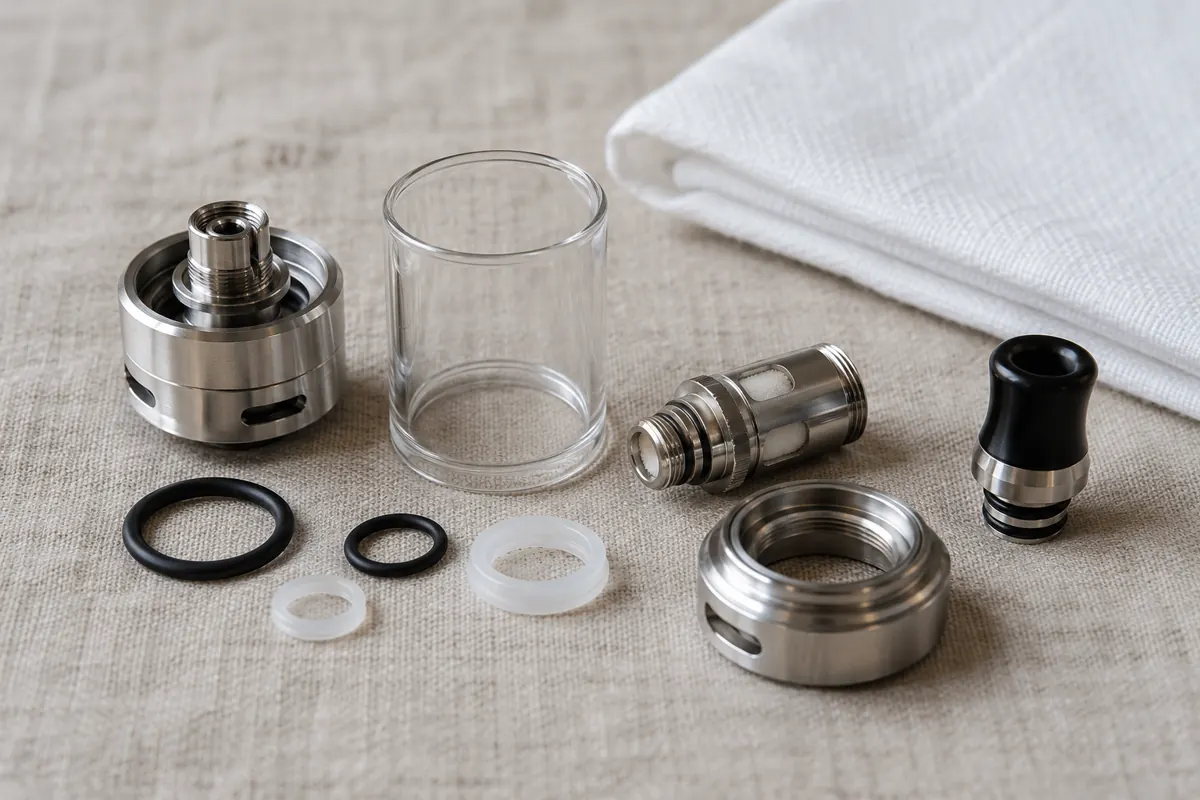
Genuine leaking is different and usually has a mechanical cause. Overfilling past the maximum line, a seal that has hardened, a cross threaded top cap, or a coil not seated squarely in its housing are the usual suspects.
Temperature plays a larger part than most people expect. Warmth thins e-liquid, so a device left in a car or a jacket in summer will pass liquid through the wicking ports faster than the coil can vaporise it.
Three habits fix most of it. Fill a little short of the line, store the device upright rather than on its side, and wipe out the airflow channel with a cotton bud every few refills.
The last cause is worth checking when nothing else explains it. A draw that is too forceful for the coil pulls liquid through the wick faster than it can be vaporised, and the excess simply arrives in the mouthpiece.
Mouthpiece shape has a bearing on vaping comfort here as well. A short, wide bore lets droplets travel straight through, whereas a longer profile or one with an internal step breaks their path and holds most of them back.
There is a seasonal pattern behind a lot of complaints. Devices weep more in summer because the liquid is thinner, and produce more condensation in winter because the vapour cools faster against cold metal, which is why the same setup can misbehave twice a year for opposite reasons.
Frequently asked questions
Why has my throat hit suddenly become harsh?
Usually the vapour volume changed rather than the liquid. A new coil, a wider airflow setting or a higher wattage all deliver more of the same bottle per puff, which reads as harsher.
How do I stop getting a burnt taste?
Prime new coils thoroughly, stay inside the wattage range printed on the coil, pause between puffs and replace the coil at the first scorched note rather than pushing on.
Where do pod leaks come from?
Most often overfilling, a hardened seal, or a coil that is not seated properly. A blend too thin for the coil fitted is the other common cause, particularly in warm weather.
Is condensation in the airflow normal?
A small amount is unavoidable. Excessive pooling suggests the draw is too forceful for the coil, or that the liquid is too thin for the wicking ports.
Should I replace the device when it becomes uncomfortable?
Rarely. Nicotine strength, wattage, airflow position and basic maintenance account for the overwhelming majority of cases, and a replacement device set up identically will behave identically.
The order to work through when something feels wrong
Resist the urge to change several things at once. Start with the coil, because it is the simplest thing to rule out and the most likely culprit, then check the wattage against the range printed on its body.
Move to the airflow next and set it deliberately rather than leaving it wherever the ring happened to stop. Only then look at the bottle, and change either the form of nicotine or the strength, never both in the same day.
Maintenance closes the loop. A wipe of the airflow channel, a check that the seals are still supple, and a refill that stops short of the line will head off most of what remains before it becomes a complaint.
Approached that way, vaping comfort turns out to be a matter of adjustment rather than equipment, and the fixes cost nothing but a little patience. Get the strength, the draw and the upkeep to agree with one another, and the setup mostly stops asking for attention. If you are still deciding which draw style you want the hardware to serve, start from our guide to MTL vaping.
Editorial content for adult readers only. Vaping products usually contain nicotine, a substance that causes addiction. Not for sale to under-18s in the United Kingdom. This article is not a buying recommendation.
Read next
Complete vape kit: what a full box should contain
What a complete vape kit should include, where UK buyers find them online, and how to check a box is genuinely ready to use before ordering.