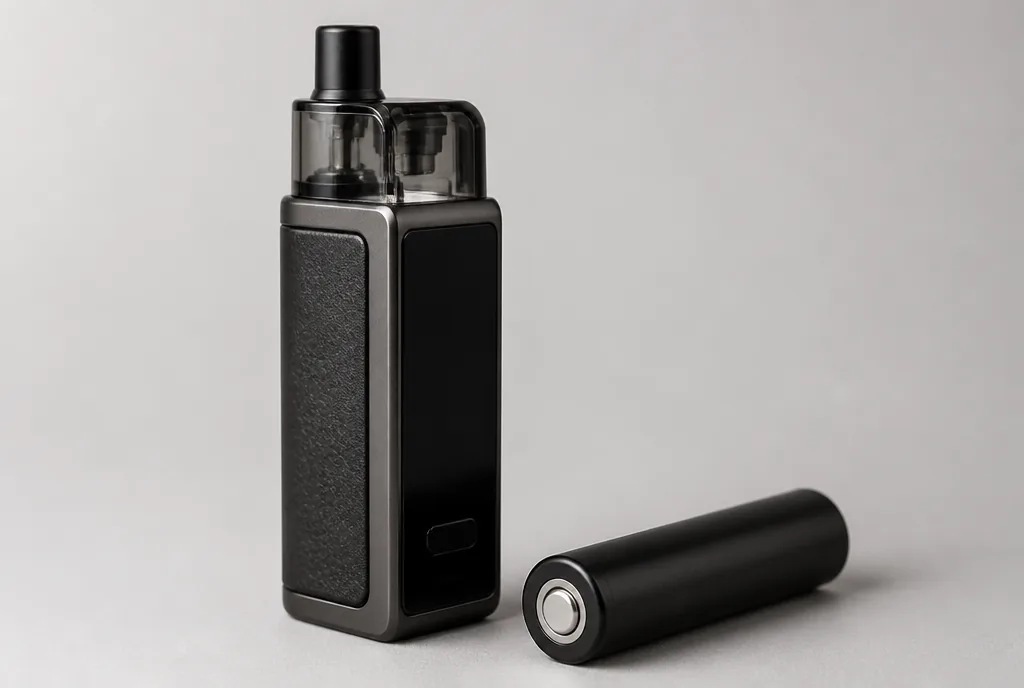
DTL vaping and RDL: what actually separates them
Past the tight end of the scale, a very different territory opens up. DTL vaping sends the vapour straight to the lungs in a single motion, with no pause in the mouth, and RDL sits deliberately between that and the restricted draw. British shops and reviewers use both abbreviations constantly, so it is worth knowing exactly what each one commits you to before you buy hardware built around one of them.
What DTL vaping means, and where RDL fits
DTL stands for direct to lung. The airflow is wide open, the draw meets almost no resistance, and the vapour goes down in one continuous inhale rather than being collected in the mouth first.
RDL stands for restricted direct to lung, sometimes written RDTL. The motion is identical, straight to the lungs, but part of the airflow is deliberately closed off, so the draw pushes back and the volume of vapour stays under control.
That single difference in air volume changes almost everything downstream. It changes the coil value the setup needs, the wattage it runs at, the e-liquid ratio that will keep up with it, and how much liquid disappears over a day.
Note the vocabulary, because it matters when you are reading British product pages. Retailers here write DTL in full rather than the two letter form used in some other markets, and RDL is used routinely rather than treated as an exotic subcategory.
Airflow, coils and power in DTL vaping
Air volume is the axis the whole comparison turns on. Everything else is a consequence of how much of it you let through the base of the tank or pod.
An open setup pairs with a low coil value, typically well under 0.6 ohm, run at a wattage that would be unusable on a narrow air path. The heat produced needs somewhere to go, and a wide airflow is what carries it away before it reaches the lips.
A restricted direct draw sits in the intermediate band, commonly quoted around 0.4 to 0.8 ohm on UK product pages. It runs at more moderate power, holds flavour more tightly, and stays comfortable for far longer sessions than a fully open configuration.
The mapping from coil value to draw style is not arbitrary, and the reasoning is worked through in our guide to coil resistance. Fit a value from one band into hardware designed for another and the result is either stifling or thin, with no middle ground.
One practical point is easy to overlook. On most adjustable tanks the airflow ring turns freely rather than clicking between positions, so a setting can shift in a pocket or during a refill without you noticing until the draw feels wrong.
What each style feels like in the hand
An open draw produces a large, warm cloud and a soft sensation in the throat. Flavour reads as broad and enveloping rather than sharply defined, and the whole experience is closer to breathing than to drawing.
The trade offs are real and immediate. Liquid consumption rises steeply, the device runs warm, battery life shortens noticeably, and none of it is especially discreet in a shared space.
A restricted direct draw keeps most of the vapour volume but reinstates some resistance at the lips. Flavour tends to come through with more precision, the device stays cooler, and the setup is far less demanding on liquid and battery across a full day.
That balance is why RDL has become so popular in Britain. It gives you the open inhale without the appetite of a fully unrestricted build, which matters a great deal when the tank on the device holds 2 ml and nothing more.
Why the British rules push against fully open setups
This is where the UK market genuinely diverges. A refillable tank or pod sold here is capped at 2 ml, nicotine e-liquid at 20 mg/ml, and bottles containing nicotine at 10 ml.
A wide open configuration vaporises liquid quickly by design, so a 2 ml tank on that kind of setup needs refilling many times over a working day. The cap was not written with cloud production in mind, and the practical friction is felt immediately.
The strength ceiling pulls the same way. High volume vapour delivers a lot from each puff, so open setups are normally used with e-liquids at the lower end of the legal scale, which in turn means the tight end of the market gets the widest choice of products.
The net effect is a market with a strong centre of gravity. Fully open builds remain a real enthusiast segment, but the mainstream sits between the restricted direct draw and the mouth to lung style described in our guide to MTL vaping.
E-liquid, nicotine and everyday practicality
Ratio is the first thing to align. Open and restricted direct setups both want a blend weighted towards vegetable glycerine, which is thicker and feeds the large cotton openings of a low value coil properly.
A thin, propylene glycol heavy blend behaves badly here. It floods the wick, leaks past the seals and can spit back through a wide mouthpiece, which is a comfort problem rather than a hardware fault.
Nicotine form matters as much as strength. Freebase is the usual pairing with high vapour volume, since salt based liquids are formulated for smoothness at strengths that suit small volumes, a distinction unpicked in our comparison of nic salts and freebase.
Strength itself stays a personal comfort question within the legal ceiling, not a number to copy from someone else. What is worth understanding is that vapour volume changes how any given strength is perceived, which is why the same bottle feels entirely different on two setups.
Frequently asked questions
What is the difference between DTL and RDL?
Both send vapour straight to the lungs in one motion. DTL leaves the airflow wide open for maximum volume, while RDL closes part of it, which tightens the draw and usually sharpens flavour.
Do open draws need sub ohm hardware?
Yes. Wide airflow only makes sense with a low value coil and the power to drive it, which is what sub ohm tanks and pods are built for.
Is RDL a sensible first step away from a tight draw?
It is the usual route. The inhale is the same single motion as a fully open draw but with far less air volume, which makes the change of technique much less abrupt.
Does an open draw really use more e-liquid?
Considerably more. More power and more vapour vaporise more liquid per puff, which is felt sharply when the tank is capped at 2 ml.
Why does my open setup leak more in warm weather?
Warmth thins e-liquid, so it passes through the wicking ports faster than the coil can vaporise it. Storing the device upright and filling a little short of the maximum both help.
Choosing between the two in practice
Start from the question of how much air you actually want, not from a cloud you have seen elsewhere. The honest test is whether a draw still feels comfortable on the twentieth puff of the day rather than on the first.
Once the style is settled, the rest falls into line without much argument. Match the coil value to the airflow band, set the wattage inside the range printed on the coil, choose a glycerine heavy blend and let the strength follow the volume of vapour rather than habit.
For most people in Britain the restricted version is the practical landing point, and DTL vaping in its fully open form remains a deliberate enthusiast choice rather than a default. Both live under the same 2 ml cap, so the setup that stays comfortable is the one whose airflow, coil and liquid were chosen together. If the draw still turns harsh or the tank keeps weeping, the fixes are gathered in our guide to vaping comfort.
Editorial content for adult readers only. Vaping products usually contain nicotine, a substance that causes addiction. Not for sale to under-18s in the United Kingdom. This article is not a buying recommendation.
Read next
Vaporesso Armour GS, setting up a direct lung draw
How to set up a direct lung draw on the Vaporesso Armour GS, from the GTX coil and the 18650 cell to the four top airflow positions.